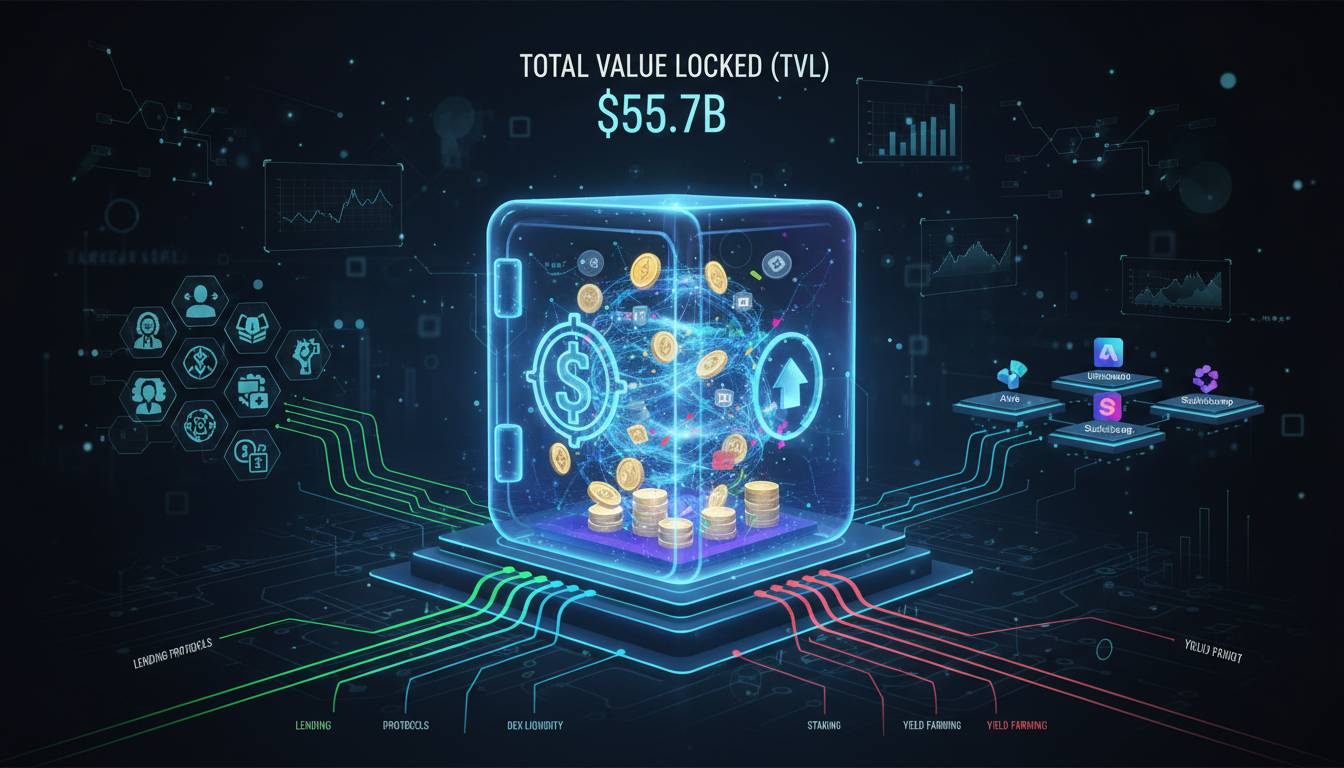
If you’ve spent any time reading about decentralized finance, you’ve encountered the term Total Value Locked — usually dropped into articles and price analyses as if everyone already knows what it means. The truth is, TVL seems simple at first glance but carries some genuine nuance once you dig into how it’s calculated, what it actually represents, and where it falls short. Understanding TVL isn’t about treating it as a perfect measure — it’s about knowing what questions it answers and which it leaves open. This guide walks through what TVL measures, how it’s calculated, why it matters, and critically, where it can mislead you.
What Does Total Value Locked (TVL) Measure?
TVL represents the total dollar value of all assets deposited into a DeFi protocol. These assets serve as collateral for loans, provide liquidity for trading pairs, or back staking positions — and TVL captures the aggregate worth of everything sitting in those smart contracts at any given moment.
Think of TVL as a snapshot of how much value users have entrusted to a protocol. When someone deposits 10 ETH into Aave as collateral, that ETH gets added to the protocol’s TVL. When a liquidity provider locks 50,000 USDC and 1 WBTC into a Uniswap pool, those assets contribute to Uniswap’s TVL. When a validator stakes 32 ETH to participate in Ethereum’s proof-of-stake mechanism, that stake counts toward the protocol’s locked value.
What TVL does not measure is token price appreciation on its own. A protocol can have the same amount of ETH deposited for months, but if ETH’s dollar value doubles, the TVL will double accordingly. This distinction matters because TVL can change for two very different reasons: user behavior (more or fewer deposits) and market conditions (asset price swings). Separating these two effects requires looking past the headline number.
Three primary categories of activity drive most DeFi TVL. Liquidity provision dominates on decentralized exchanges like Uniswap and Curve, where users pool two assets to enable trading. Lending protocols like Aave and Compound generate TVL from collateral deposits and supplied assets. Staking and yield farming operations contribute when users lock tokens to earn rewards or participate in protocol governance.
How Is TVL Calculated?
The calculation itself is straightforward: you sum the value of all locked assets and express that total in a common unit, typically US dollars. The formula involves taking every deposit address associated with a protocol, identifying what tokens sit in each, multiplying each token amount by its current price, and adding everything together.
Consider a hypothetical lending protocol with three users. User A deposits 100 ETH (worth approximately $170,000 at $1,700 per ETH). User B deposits 50,000 USDC. User C deposits 10 BTC (worth roughly $650,000 at $65,000 per BTC). This protocol’s TVL would be $170,000 plus $50,000 plus $650,000, totaling $870,000.
Data aggregators like CoinGecko, CoinMarketCap, and DeFiLlama perform these calculations across hundreds of protocols, updating figures as prices fluctuate and as users deposit or withdraw. The methodology seems simple, but subtle differences in how aggregators count assets can produce varying TVL figures for the same protocol. Some exclude certain token types, handle wrapped assets differently, or adjust for double-counting when the same underlying collateral appears in multiple places.
Why Does TVL Matter in DeFi?
TVL is a rough proxy for protocol adoption and user trust. A higher TVL generally indicates that more people are willing to lock their assets into a protocol’s smart contracts, which suggests confidence in the protocol’s security and utility. For comparison purposes, TVL lets you look at two lending protocols or two DEXs and immediately see which one handles more user funds — useful for getting a sense of relative size.
Liquidity depends heavily on TVL. In trading contexts, higher TVL in a liquidity pool typically means tighter spreads and less slippage for users executing trades. A Uniswap pool with $50 million in TVL will offer far better pricing than one with $50,000, simply because the larger pool can absorb bigger trades without moving the price dramatically. This relationship between TVL and trading quality is why liquidity providers matter so much to decentralized exchanges.
Investors and analysts also watch TVL trends to gauge momentum. A protocol gaining TVL over weeks or months is attracting capital — a positive signal. Losing TVL suggests users are withdrawing funds, which could indicate emerging problems with the protocol, better opportunities elsewhere, or broader market stress. Tracking TVL over time reveals patterns that raw numbers alone cannot.
The metric also affects token valuation in some projects. Certain DeFi tokens distribute rewards based on TVL or use TVL as a factor in determining staking rewards or governance weight. Understanding a protocol’s TVL helps you anticipate how its native token economics might play out.
TVL vs Market Cap: What’s the Difference?
This distinction trips up many newcomers, and honestly, the confusion is understandable. Both metrics involve dollars and tokens, but they measure completely different things.
Market cap refers to the total value of a cryptocurrency token’s circulating supply. You calculate it by multiplying the current price of a single token by how many tokens exist in circulation. If a token trades at $10 and 100 million tokens are in circulation, the market cap is $1 billion. Market cap tells you what the market collectively believes the project is worth — it’s a valuation metric.
TVL, by contrast, measures actual user deposits in the protocol, not the protocol’s token. The two can diverge dramatically. A protocol might have a massive market cap driven by speculative token trading while holding relatively modest user deposits. Alternatively, a protocol with enormous TVL might have a tiny token market cap if the token itself isn’t heavily traded or valued.
Here’s where it gets interesting: a low TVL relative to market cap often signals that the token price is detached from actual protocol usage. If a governance token trades at $500 million market cap but the protocol only holds $50 million in deposits, you’d reasonably question whether that valuation is justified. Conversely, a high TVL relative to token market cap might suggest the token is undervalued — or that the token economics simply don’t link the token to protocol revenue in a meaningful way.
Limitations of TVL
Anyone who’s worked with DeFi data long enough has run into TVL’s blind spots. The metric has genuine value, but it also carries systematic biases that can lead you astray if you treat it as a complete picture.
Token price volatility creates the most obvious distortion. When the crypto market crashes, TVL drops across the board — not because users are withdrawing, but because the assets they deposited are worth less in dollar terms. The 2022 market downturn saw DeFi’s aggregate TVL plummet from over $250 billion to under $100 billion, yet user deposits hadn’t changed substantially. Interpreting TVL movements requires separating price effects from behavior effects.
Cross-chain counting introduces another layer of complexity. Many protocols deploy across multiple blockchains — Aave on Ethereum, Polygon, Avalanche, and others. If you simply add up all the deposits across chains, you might count the same user funds multiple times. Aggregators handle this differently, which explains why you sometimes see conflicting TVL figures for the same protocol.
Incentive programs skew TVL artificially in both directions. When protocols offer lucrative yield farming rewards, depositors flood in chasing the returns — but those returns often come from the protocol’s own token printing, not from sustainable revenue. Once rewards dilute or end, TVL often drains just as quickly. You can’t simply look at a high TVL number and conclude the protocol has found product-market fit.
Finally, TVL says nothing about capital efficiency. A protocol might hold $1 billion in deposits but generate minimal actual activity — users might be supplying assets but nobody borrows against them. The TVL number looks impressive while the protocol sits largely dormant. Measuring usage requires looking at metrics like trading volume, loan origination counts, or active addresses, not just TVL.
Examples of TVL in Major DeFi Protocols
Looking at real numbers makes these concepts concrete. Uniswap, the largest decentralized exchange by volume, frequently holds billions in combined TVL across its various liquidity pools. As of late 2024, Uniswap’s TVL typically hovers between $3 billion and $5 billion depending on market conditions. The bulk of this value sits in popular trading pairs like ETH/USDC, WBTC/ETH, and USDC/USDT. Each of these pools represents millions of dollars that liquidity providers have deposited to facilitate trading.
Aave, one of the largest lending protocols, operates somewhat differently. Its TVL consists primarily of collateral that borrowers deposit to secure loans. Users supply assets like ETH, USDC, or stETH, and those deposits count toward Aave’s TVL. Aave’s TVL has historically ranged from $5 billion to $15 billion, with significant variation based on borrowing demand and asset valuations. What makes Aave interesting is that its TVL serves a dual purpose — it’s both user deposits and the backing that enables the lending mechanism to function.
Compound, another major lending protocol, follows a similar model to Aave but typically operates at a smaller scale. Compound’s TVL has fluctuated between $1 billion and $3 billion in recent periods. The protocol’s relatively conservative approach to listed assets and risk parameters tends to attract a more risk-averse user base compared to more aggressive competitors.
MakerDAO, the protocol behind the DAI stablecoin, presents a different TVL profile. Its TVL consists of collateral vaults that users lock to generate DAI loans. This collateral typically includes ETH, stablecoins, and real-world assets in some configurations. MakerDAO’s TVL often exceeds $5 billion when ETH prices are favorable, making it one of the largest DeFi protocols by this metric.
Frequently Asked Questions About TVL
How is TVL calculated in DeFi?
TVL is calculated by summing the dollar value of all assets deposited into a DeFi protocol’s smart contracts. Each deposit is valued at its current market price, and the total is expressed in a common unit, typically US dollars. Aggregators like DeFiLlama and CoinGecko perform these calculations continuously across thousands of protocols.
Why does TVL matter in DeFi?
TVL matters because it indicates the amount of capital users have entrusted to a protocol, serving as a measure of adoption, liquidity, and user trust. Higher TVL generally means more liquidity for trading and borrowing, plus a stronger signal that users believe the protocol is secure and useful.
What is a good TVL for a DeFi protocol?
“Good” TVL depends entirely on the protocol type, its age, and the market context. A new lending protocol with $10 million in TVL might represent strong early traction, while a mature exchange with only $10 million would indicate serious problems. Context matters far more than the absolute number.
What are the main limitations of TVL?
The primary limitations include vulnerability to token price swings (which change TVL without any change in user behavior), potential cross-chain double-counting, and insensitivity to actual protocol usage. A protocol can have high TVL with minimal activity, or lose TVL purely from price decline while user deposits remain steady.
Conclusion
TVL remains one of the most useful single metrics for understanding DeFi, but using it wisely requires knowing what it doesn’t tell you. The number answers one specific question — how much value users have deposited into a protocol’s contracts — while leaving many others unanswered. Is that deposit being productively used? Is the protocol generating real revenue? Will those deposits stay once yield incentives disappear?
The DeFi space continues evolving rapidly, and TVL’s role in evaluating protocols will likely shift as new financial primitives emerge and as the market matures beyond simple TVL comparisons. What hasn’t changed is the underlying need: you need some way to compare protocol scale, and until something better comes along, TVL fills that role — with all its imperfections acknowledged. The smartest analysts treat it as a starting point, not a final verdict.