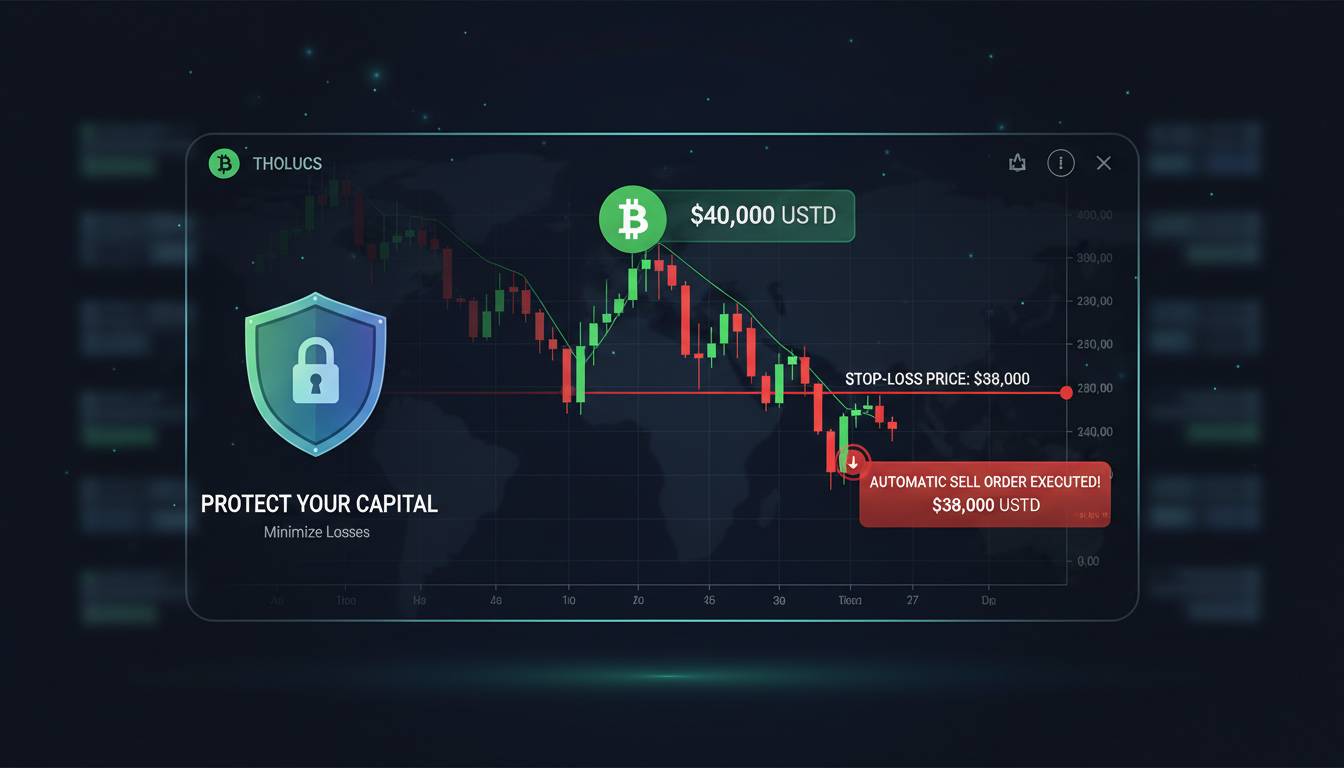
If you’ve ever woken up to see your portfolio down 15% overnight, you already understand why traders worry about risk management. The market doesn’t care about your cost basis, your investment timeline, or how long you spent researching a coin. It moves when it moves, and it can erase months of gains in hours. This is exactly why stop-loss orders exist—they’re a basic tool that serious traders use to manage risk.
A stop-loss order is your automated exit strategy. It’s an instruction you give to your exchange to sell your cryptocurrency when the price drops to a predetermined level. Instead of staring at charts obsessively or hoping you’ll remember to check prices at 3 AM, you set the order once and walk away. The exchange executes the sale automatically.
This article covers how stop-loss orders work, the different types available, how to set appropriate stop-loss percentages, and the honest limitations you need to understand before relying on them.
What is a Stop-Loss Order?
A stop-loss order is a type of sell order that activates only when the market price reaches a specified price point—called the stop price. Unlike regular market orders where you decide when to sell, a stop-loss order waits in the background until conditions are met. The moment the price hits or drops below your stop price, the order becomes a market order and executes at the best available price.
Here’s why this matters in crypto: the market is open 24 hours a day, 365 days a year. Bitcoin doesn’t sleep, and neither do the algorithms hunting for liquidity. If you’re holding a position and the price suddenly crashes, you might not be able to log into your exchange in time to sell manually. Your stop-loss order is already there, watching the price, ready to act.
Let’s make this concrete. Suppose you bought Ethereum at $2,800. You don’t want to lose more than 10% of that position, so you set a stop-loss at $2,520. If ETH drops to $2,520, your stop-loss triggers and sells your holdings automatically. Your maximum loss on this trade is $280 per token—or roughly 10% of your initial investment. Without the stop-loss, you might have watched the price drop to $2,200, $1,800, or worse, depending on how severe the crash was.
How Does a Stop-Loss Order Work?
The mechanics are straightforward, but understanding the execution details matters in practice.
When you place a stop-loss order, you’re telling your exchange: “When the price reaches X, sell my holdings.” Once the market price hits X, the order converts to a market order and executes at the next available price. This distinction is important—stop-loss orders don’t guarantee a specific sell price; they guarantee execution when the price threshold is breached.
There are two execution scenarios you need to understand. In normal market conditions, when the price drops to your stop price, the order executes at or near that price. But in extreme volatility—during a sudden crash or a flash crash—slippage occurs. The price might gap down past your stop level, and your sell order executes significantly lower than you expected. This is called “stop-loss hunting” or being “stopped out” at a worse price than intended.
Here’s a real example. Imagine you set a stop-loss on your Solana position at $145. The price drops to $145.10, your stop triggers, and the order executes at $144.82—a small slippage of about 0.2%. Annoying, but manageable. Now imagine the same day, major news breaks and the price gaps down from $148 to $138 in minutes. Your stop triggers at $145, but the order fills at $138 instead. You’ve lost more than your intended 10% risk because the market literally skipped over your stop price.
This is why understanding execution mechanics matters. Stop-loss orders protect you from human hesitation and from losses during periods when you can’t actively monitor the market. They don’t protect you from market gaps.
Types of Stop-Loss Orders
Not all stop-loss orders work the same way. Different order types give you varying degrees of protection and control.
Standard Stop-Loss (Market Stop)
This is the most common type. When the stop price is reached, the order converts to a market order and sells at whatever the current market price is. It’s simple and reliable, but subject to slippage during volatile periods.
Stop-Limit Order
With a stop-limit, you set two prices: the stop price and the limit price. When the stop price is reached, the order converts to a limit order instead of a market order. It will only execute at your limit price or better. The risk here is that if the price crashes past your limit, your order sits unfilled while the price continues falling. A stop-limit at stop $145, limit $142 means your sell order will only fill if the price is $142 or higher after triggering. If the price drops to $140 and keeps falling, your order never executes.
Trailing Stop-Loss
This is where things get interesting. A trailing stop moves with the price—it maintains a set distance (either a dollar amount or percentage) below the highest price reached since you placed the order. Let’s say you buy Bitcoin at $50,000 and set a trailing stop with a 5% trail. As Bitcoin rises to $55,000, your trailing stop follows at $52,250 (5% below $55,000). If Bitcoin then drops to $52,250, the trailing stop triggers and sells. But if Bitcoin keeps rising to $60,000, your trailing stop moves up to $57,000. You’re locking in profits while giving the trade room to run.
Time-Based Stop-Loss
Some exchanges let you set stop-losses that expire after a certain time period. If the price hasn’t reached your stop level by the expiration, the order simply cancels. This is useful if you’re trading based on a specific catalyst or timeframe.
How to Set a Stop-Loss Order
Setting a stop-loss order is a straightforward process on most major exchanges, though the exact interface varies.
On Binance, you navigate to the trading section, select your trading pair, choose “Stop-Limit” from the order type dropdown, enter your stop price and limit price, specify the amount, and confirm the order. Coinbase Pro offers similar functionality under their “Stop” order type. Kraken calls them “stop loss market” and “stop loss limit” orders in their advanced trading interface.
The practical question isn’t how to click the buttons—it’s where to set your stop price. This is where most traders struggle.
Technical analysis provides several frameworks. Support levels are prices where buying pressure has historically prevented further declines—if you bought at a breakout above a resistance level, setting your stop just below that former resistance gives the trade room to work while protecting you if the breakout fails. Moving averages, particularly the 50-day and 200-day moving averages, often act as dynamic support levels. Setting stops below these can work for trend-following strategies.
Here’s a practical example. Suppose you bought Polygon (MATIC) at $0.85 after it broke above $0.80 resistance. The former resistance at $0.80 now acts as support. You might set your stop-loss at $0.76—giving the trade room below support while protecting you if the price drops back through the $0.80 level. That’s roughly a 10.5% stop, which is reasonable for a breakout trade.
What is the Best Stop-Loss Percentage for Crypto?
This is the question I get asked most, and I’ll give you the answer every experienced trader will give you: there is no universal best percentage.
Your stop-loss percentage depends on your risk tolerance, your trading timeframe, and the volatility of the specific cryptocurrency you’re trading.
For short-term trades and day trading, tighter stops of 1-3% are common. You’re making small bets on small moves, and you can’t afford to wait for the trade to work if it immediately goes against you. A 3% loss on a day trade is actually significant—four losing day trades in a row wipes out 12% of your capital.
For swing trades spanning days to weeks, 5-10% stops are more typical. You’re giving the trade room to breathe while still limiting your downside. In this timeframe, a cryptocurrency might reasonably fluctuate 5-8% against you before the trade idea is invalidated.
For long-term positions held for months or years, some investors use much wider stops of 15-25%, or they don’t use stop-losses at all—they simply accept that they’ll hold through volatility. Warren Buffett doesn’t use stop-losses on his stock holdings, and some crypto investors apply the same philosophy to their long-term holdings.
Volatility matters enormously. A 5% stop on a relatively stable asset like Bitcoin might be appropriate, but the same 5% stop on a smaller cap token could get triggered by normal daily fluctuations. Chainlink or Polygon might swing 5-8% on an ordinary day, while Bitcoin might move 2-3%. Setting your stop based on the asset’s typical price range—not just an arbitrary percentage—makes more sense.
My honest recommendation: start with a 10% stop on new positions and adjust based on the specific asset’s behavior and your personal comfort with losses. If you’re losing sleep over positions, your stops are too tight. If you’re consistently losing more than 10% before your stops trigger, they’re too wide.
Stop-Loss vs Take-Profit: Understanding the Difference
Stop-loss and take-profit orders are two sides of the same coin. A stop-loss limits your losses; a take-profit locks in your gains.
Here’s how they work together. When you enter a trade, you should ideally know both your maximum acceptable loss and your profit target. Using our earlier Ethereum example: you bought at $2,800 with a maximum loss tolerance of 10%, so your stop-loss goes at $2,520. But you also have a profit target—let’s say you expect Ethereum to reach $3,400 based on your analysis. You could set a take-profit order at $3,400 to automatically exit when your target is reached.
The strategic debate here is whether take-profit orders are helpful or harmful. Some traders swear by them—they ensure you actually take profits rather than watching gains evaporate when the price retraces. Other traders argue that take-profit orders limit your upside because the market might be trending strongly and you’d be better off letting profits run.
My take: take-profit orders are valuable for two scenarios. First, when you’ve achieved an asymmetric risk-reward ratio—say your risk is 5% but your target is 20%, taking profit at 20% when you get there makes sense. Second, when you’re trading a specific catalyst and know the price will likely drop after that catalyst plays out. For general trend-following, trailing stops often serve better than fixed take-profit orders because they let you stay in winning trades longer.
Risks and Limitations You Need to Know
I’m going to be honest with you: stop-loss orders are not foolproof protection, and treating them as such will cost you money.
The first limitation is slippage. I’ve already discussed this, but it bears repeating—during extreme market conditions, your stop-loss will execute at a worse price than you planned. In December 2022, when FTX collapsed, the entire crypto market gapped down violently. Many traders woke up to find their stop-losses executed 20-30% below their stop prices. The exchange did exactly what it was supposed to do—the order triggered and executed. But the protection was far less than expected.
The second limitation is that stop-losses can trigger during normal volatility. If you’re trading a volatile token and set a 5% stop, expect to get stopped out occasionally by ordinary price fluctuations. This is psychologically brutal—you’ll sometimes be right about a trade direction but wrong about timing, and you’ll watch the price recover right after you were stopped out. This is called “stop hunting” or being “whipsawed.”
The third limitation is exchange failures. Exchanges go down. During the May 2021 crash, several major exchanges experienced outages precisely when traders needed their stop-losses to execute most. If you can’t log into your exchange to place an order, your stop-loss order is useless. This is why some traders use multiple exchanges or use decentralized tools as backups.
Finally, stop-losses don’t work on all order types or trading pairs on all exchanges. Some exotic trading pairs or DeFi protocols may not support stop-loss functionality. Always verify that stop-loss orders are available before entering a position.
Frequently Asked Questions
How does a stop-loss order work in crypto?
A stop-loss order is an automated instruction to sell your cryptocurrency when the price drops to a specified level. You set the stop price, and when the market price reaches that threshold, the order converts to a market order and executes at the best available price. This protects you from larger losses if the price continues falling after your stop is triggered.
What is the best stop-loss percentage for crypto?
There’s no universally best percentage. Short-term traders often use 1-3%, swing traders use 5-10%, and long-term investors might use 15-25% or skip stop-losses entirely. The appropriate percentage depends on the asset’s volatility, your trading timeframe, and your personal risk tolerance. Start with 10% as a reasonable default and adjust based on the specific cryptocurrency.
Should I use stop-loss on crypto?
Yes, if you’re actively trading or holding volatile cryptocurrencies. Stop-loss orders protect you from significant losses during times when you can’t monitor the market. Long-term holders who are comfortable holding through volatility might not need them, but for anyone managing active positions, they’re useful risk management tools.
What is the difference between stop-loss and take-profit?
A stop-loss order sells when the price drops to your specified level (limiting losses), while a take-profit order sells when the price rises to your target (locking in gains). Stop-loss protects your downside; take-profit secures your upside.
Can you lose more than you invest with stop-loss?
In normal market conditions, no—a stop-loss sells your holdings, so you can only lose your investment in that position. However, during extreme volatility with significant slippage, your actual loss can exceed your intended stop-loss percentage. Additionally, if you’re using leverage or margin, you can lose more than your initial investment.
Conclusion
Stop-loss orders are useful risk management tools for anyone trading cryptocurrency. They automate your exit strategy, protect you from emotional decision-making, and limit your downside in a market that can turn against you without warning.
But they’re not perfect. Understand that slippage will sometimes make your actual losses worse than planned, that normal volatility will occasionally stop you out before the trade works, and that exchange outages can render them useless when you need them most. Use stop-losses as part of a comprehensive trading plan—not as a replacement for good judgment.
The best traders I know don’t just set stop-losses and forget them. They revisit their stop levels as trades develop, adjust for changing volatility, and accept that sometimes the market will do things that seem unfair. That’s crypto. Protect yourself, but never mistake protection for certainty.