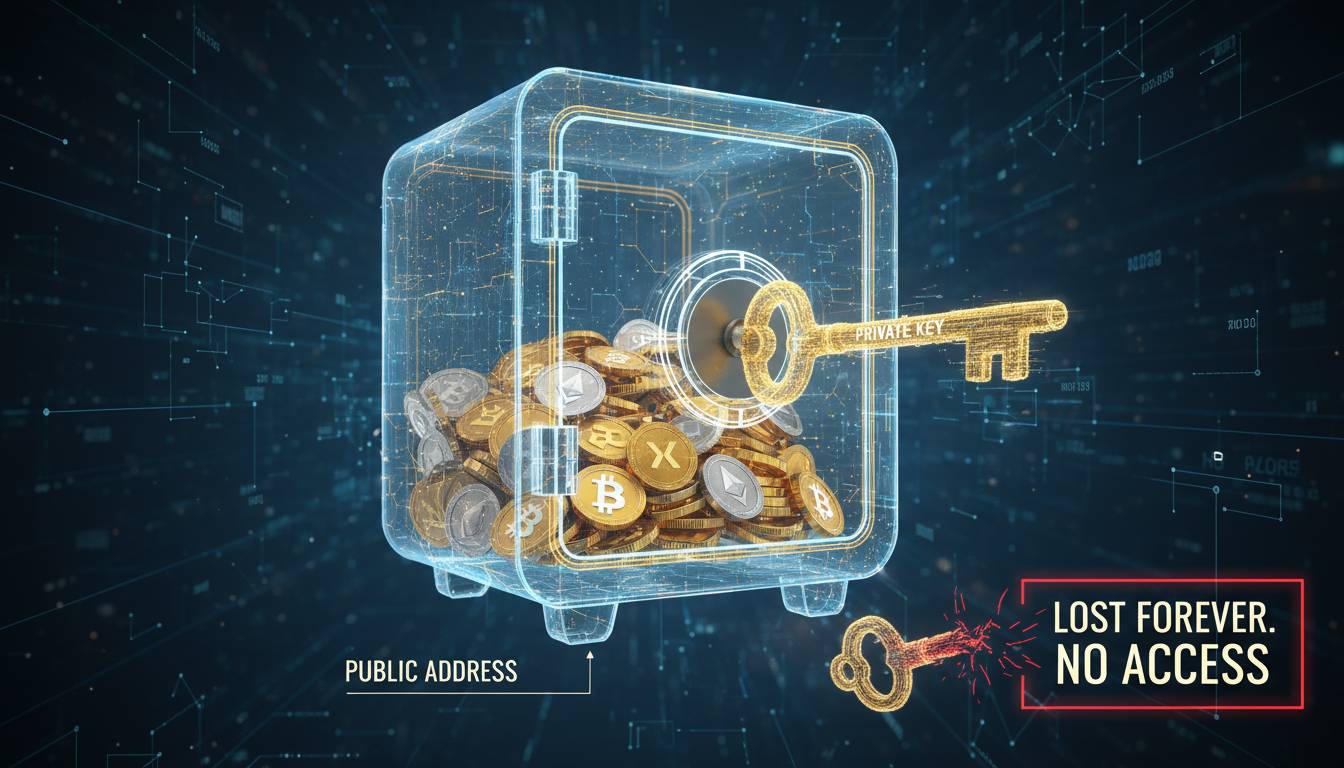
A private key is a secret cryptographic string that proves you own the cryptocurrency in your wallet. Unlike a bank account password that can be reset through customer support, your private key is the only thing standing between you and your funds—lose it, and there’s no help coming. This article breaks down exactly what private keys are, how they work, and why their loss is absolutely permanent.
What Is a Private Key in Cryptocurrency?
A private key is a 256-bit number—essentially a string of 64 characters using letters and numbers—that gives you complete control over your cryptocurrency. When you set up a crypto wallet, whether on Coinbase, Ledger, or any other platform, the wallet generates this key mathematically. The key lives on your device or, ideally, on a hardware wallet that keeps it offline.
Think of it like the combination to a safe. If someone learns that combination, they can open your safe and take everything inside. If you forget the combination and have no backup, the safe becomes permanently inaccessible. No amount of calling the safe manufacturer will help—they simply don’t have a master key.
Your private key also serves as your digital signature. When you send cryptocurrency, the network uses your private key to verify that you authorized the transaction. Without it, you cannot sign messages or move funds. The math behind private keys makes it computationally impossible for anyone else to forge your signature.
The private key is mathematically linked to a public key, which acts like your account number that you can share with others to receive funds. But here’s the crucial point: knowing the public key tells you nothing about the private key. You can give out your public key freely without compromising your funds, but sharing your private key is catastrophic.
Private Key vs. Public Key: Understanding the Difference
The relationship between private and public keys is one of the most important concepts in cryptocurrency, yet it’s frequently misunderstood by newcomers.
Your public key is derived mathematically from your private key—it can be shared openly, like your bank account number or email address. Anyone can send cryptocurrency to your public key. That’s the whole point: it’s your receiving address.
Your private key, by contrast, must be kept absolutely secret. It is the mathematical proof that you are the owner of the funds associated with your public key. The cryptographic relationship between the two means that while it’s easy to calculate a public key from a private key, doing the reverse is computationally infeasible.
To use an imperfect but helpful analogy: your public key is like a mailbox slot that anyone can drop letters into. Your private key is like the key that opens the mailbox to retrieve those letters. Anyone can put mail in, but only you can take it out—if you lose that key, the mail sits there forever, and no locksmith can help.
Modern wallets rarely display the raw private key to users. Instead, they generate a seed phrase—typically 12 or 24 words—that serves as a human-readable representation of your private key. This seed phrase can regenerate your private key if needed. But here’s the critical point: the seed phrase IS your private key in a different format. Treat it with the same care.
Why Losing Your Private Key Means Losing Your Crypto Forever
This is the reality of how cryptocurrency works, and it’s the reason you’re reading this article.
Cryptocurrency operates on a principle called “code is law.” The blockchain doesn’t know you. It doesn’t know your name, your identity, or your circumstances. It only knows cryptographic proof—and your private key is that proof. When you lose your private key, the blockchain has no mechanism to verify that the funds belong to you. The coins sit on the blockchain, technically still there, but completely inaccessible.
Unlike traditional financial institutions, there is no customer support team to call. There is no “forgot password” link. There is no identity verification process that can recover your account. Binance cannot recover your funds. Coinbase cannot recover your funds. Ledger cannot recover your funds. Not because they don’t want to help—they physically cannot. The mathematics of cryptocurrency prevent anyone from accessing your funds without the private key.
This has actually happened on a massive scale. In 2010, a man named James Howells accidentally threw away a hard drive containing 7,500 bitcoins. At current prices, that’s worth hundreds of millions of dollars. He’s been trying to get permission from a Welsh landfill to excavate it ever since. There are other stories like this—early Bitcoiners who generated coins on computers they later discarded, people who lost their seed phrases in house fires, investors who forgot about wallets they created years ago. Researchers estimate that roughly 20% of all Bitcoin has been lost permanently. Some of those people are multimillionaires in theory but have no way to access their holdings.
The harsh truth is that cryptocurrency was designed this way intentionally. Decentralization requires that no central authority can reverse transactions or recover accounts. This same feature that protects you from government seizure or corporate interference also means that your keys, your coins. There’s no safety net.
How Private Keys Work in Practice
Here’s what actually happens when you interact with cryptocurrency.
When you create a wallet with a service like MetaMask, the application generates a random number. That number becomes your private key. The wallet then performs cryptographic operations to derive your public key from this number, and then derives your wallet address from the public key. All of this happens automatically—you never see the actual private key.
When you want to send cryptocurrency, your wallet uses your private key to create a digital signature. This signature is unique to both the transaction and your private key. When the network receives your transaction, it verifies that the signature is valid without ever learning what your private key is. This is the elegance of asymmetric cryptography—the math allows verification without disclosure.
If you use a hot wallet (software connected to the internet), your private key is stored on your computer or phone. This is convenient but introduces security risks—malware could potentially access your key. Hardware wallets, like those from Ledger or Trezor, store your private key on a dedicated device that never exposes the key to your computer. When you sign a transaction, the hardware wallet performs the cryptographic operation internally and only sends the signature to your computer.
Cold storage—keeping your private key completely offline—is widely considered the most secure method for holding significant cryptocurrency. Paper wallets, where you print your private key or seed phrase and store it physically, were once popular but are now discouraged due to risks of physical loss or damage.
How to Keep Your Private Key Safe
Protecting your private key means thinking about multiple failure scenarios. These methods work:
Hardware wallets are the standard for serious security. Devices like the Ledger Nano X or Trezor Model T store your private key on secure elements that never expose it to your computer. Even if your computer is compromised with malware, the attacker cannot access your keys. The tradeoff is that you need to purchase the device from an official source and verify it hasn’t been tampered with before use.
Seed phrase backups are essential. Write your 12 or 24-word seed phrase on paper—multiple copies, stored in separate secure locations. Consider using metal backup solutions like Cryptosteel or Billfodl, which survive fires and floods. Never store your seed phrase digitally—never take a photo of it, never type it into a computer, never store it in a password manager.
Diversify your storage. Don’t keep all your cryptocurrency in one place. Use a hardware wallet for your long-term holdings, keep a smaller amount in a mobile wallet for convenience, and ensure your seed phrase backup is geographically separated from your hardware wallet.
Test your recovery process. Before depositing significant funds, restore your wallet from your seed phrase on a different device. Verify you can access your funds. This practice ensures your backup works and that you’ve recorded your seed phrase correctly.
Common Mistakes to Avoid
One of the most frequent mistakes is entering your seed phrase into a phishing website. Attackers create fake wallet websites or apps that look identical to legitimate ones. When you try to “restore” your wallet, you’re actually sending your seed phrase directly to the attacker.
Another common error is storing seeds in easily stolen locations. If you keep your seed phrase in a desk drawer and someone breaks into your home, they have everything. Safe deposit boxes can be a better option, though they have their own risks.
Some people split their seed phrase, thinking that hiding pieces in different locations adds security. This approach is risky—if you lose any piece, you lose everything. Additionally, anyone who finds even part of your seed phrase may be able to reconstruct the rest through brute force if they know which wallet software you use.
Hardware wallets, while secure, aren’t invincible. If you buy a used hardware wallet, it could have been tampered with. Always purchase directly from the manufacturer and verify any security seals. Firmware updates can sometimes introduce vulnerabilities—research any update before applying it to a wallet holding significant funds.
Frequently Asked Questions
What happens if I lose my private key?
If you lose your private key and have no backup of your seed phrase, your cryptocurrency is gone forever. There is no customer support to call, no identity verification process, no way to reset it. The funds remain on the blockchain but become permanently inaccessible.
Can someone guess my private key?
The number of possible private keys is approximately 2^256—a number so large that it’s effectively impossible to guess. Even if every computer on Earth worked together for the entire age of the universe, the probability of finding a specific private key would be effectively zero.
Is a private key the same as a password?
No. A password can be reset by a company if you forget it. A private key cannot be reset, recovered, or retrieved by anyone. Your private key is mathematically provable ownership of your funds, not an authentication credential.
Can I recover my crypto if I lose my private key?
Only if you have your seed phrase or another backup of your private key. Without that backup, no recovery is possible. This is by design—it’s what makes cryptocurrency decentralized and censorship-resistant.
Conclusion
The permanence of private key loss is not a bug—it’s a feature that makes cryptocurrency possible. Understanding this fundamental reality is what separates responsible crypto users from those who learn expensive lessons.
Your private key is your identity in the crypto world. Treat it accordingly. Back it up properly, store it securely, and never, under any circumstances, share it with anyone. There’s no safety net, no customer support, no second chance. The blockchain doesn’t care about your circumstances, your losses, or your regrets. It only knows the math.
If you’re holding cryptocurrency and haven’t verified that you have a secure backup of your seed phrase, go do that now. The only thing standing between you and permanent loss is that list of words somewhere in your possession.