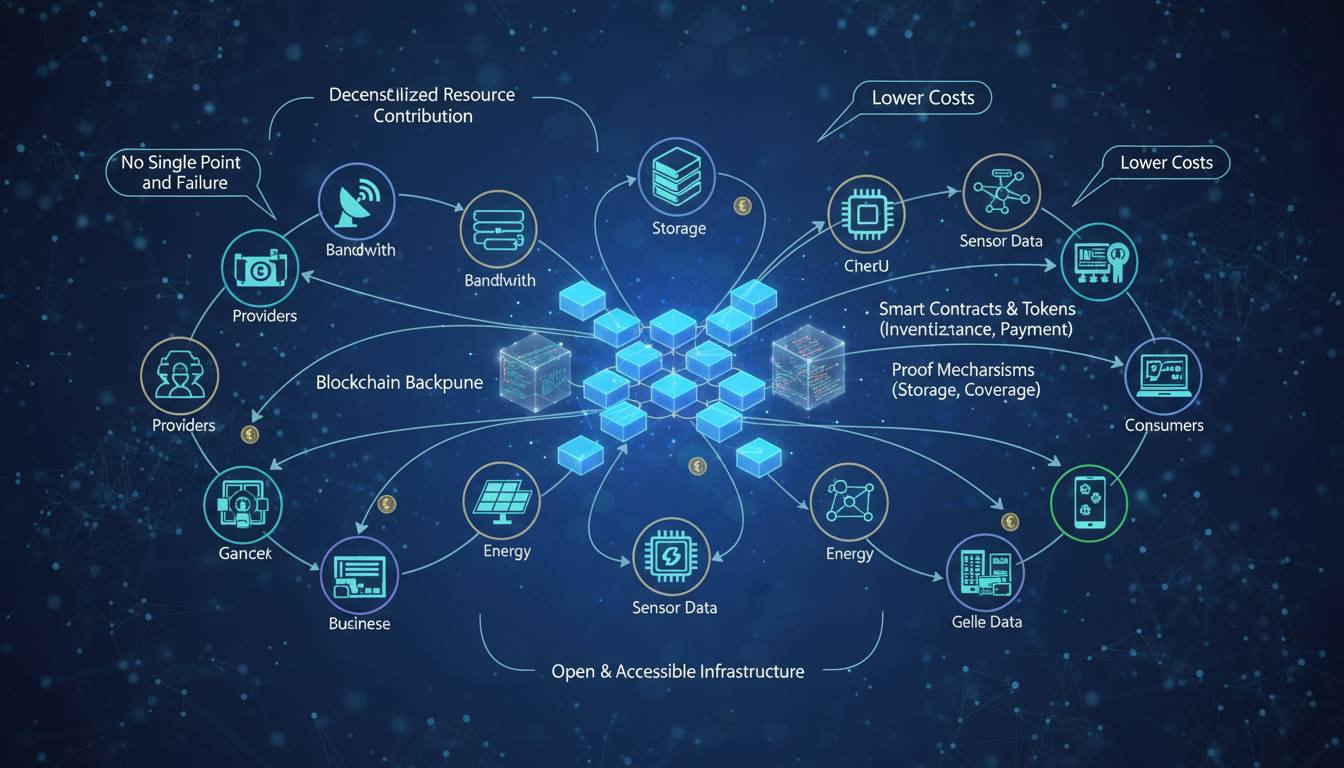
The infrastructure that powers our digital world is broken. Not in some abstract, philosophical way—in the practical sense that the companies building wireless networks, storage systems, and compute power have become expensive monopolies that pass their inefficiencies directly to users. Decentralized Physical Infrastructure Networks offer a fundamentally different model: instead of one corporation building and owning the towers, servers, and sensors, thousands of small operators collectively own the infrastructure and earn tokens for their contribution. The implications for how we build and pay for the physical layer of the internet are massive, and most people outside crypto circles haven’t even heard the term yet.
This article explains what DePIN actually is, how the mechanics work beneath the jargon, which projects are worth watching, and where the model still has serious gaps that its proponents prefer not to discuss.
What DePIN Actually Is
DePIN stands for Decentralized Physical Infrastructure Networks. It’s a category of Web3 projects that use blockchain tokens to incentivize individuals and businesses to build real-world infrastructure—wireless hotspots, storage capacity, compute power, energy grids—rather than relying on centralized corporations to own and operate everything.
The core idea is simple: traditional infrastructure companies are asset-heavy, capital-intensive businesses with enormous overhead. They raise billions to build networks, then spend years trying to recoup those costs through subscription fees and service contracts. DePIN flips this by treating infrastructure as a community resource. Anyone can buy or deploy hardware—helium hotspots, Filecoin storage nodes, Render graphics cards—and earn network tokens in return for providing capacity.
The market opportunity has drawn serious capital. According to Messari’s 2024 research, DePIN protocols collectively held over $3.5 billion in total value locked as of late 2024, up from roughly $500 million in early 2023. That’s growth, but it’s still a rounding error compared to traditional infrastructure spending. The gap between current DePIN valuation and the addressable market is precisely why this space generates both excitement and skepticism in equal measure.
What makes DePIN different from earlier Web3 concepts is that it’s not purely digital. These aren’t just smart contracts running on servers somewhere—they’re physical devices in the real world, transmitting wireless signals, storing actual data on hard drives, and performing computational work. The blockchain coordinates the incentives and verifies contributions, but the infrastructure is tangible.
The Mechanics Behind DePIN
Understanding how DePIN works requires grasping three interlocking systems: token incentives, proof of contribution, and network coordination. Each one is necessary; none is sufficient on its own.
Token Incentives That Actually Work
The token model is what makes DePIN different from a traditional cooperative. When you deploy a Filecoin storage node, you’re not just providing a service—you’re locking up capital in hardware and earning tokens that appreciate as network demand grows. The token serves two functions: it rewards early participants for taking on risk, and it creates a governance stake in network decisions.
Helium, the most established DePIN project, illustrates this clearly. Users deploy small wireless hotspots that provide LoRaWAN connectivity for IoT devices. In return, they earn HNT tokens. The protocol adjusts token emissions based on network growth—more hotspots means more tokens distributed, creating a direct incentive loop. As of early 2025, Helium has over 400,000 hotspots active globally, covering hundreds of cities where traditional carriers never bothered to deploy LoRaWAN.
One thing worth noting: these token rewards are not guaranteed. They’re algorithmic, meaning the protocol mathematically determines issuance based on supply and demand parameters. Early adopters in 2019 and 2020 earned substantially more per hotspot than someone deploying today. The APY has compressed significantly as the network scaled. This isn’t a bug—it’s how the model is supposed to work—but it’s crucial for anyone considering participation to understand that the reward rate declines as the network matures.
Proof of Contribution
The second mechanism is proof of contribution—the method networks use to verify that participants are actually providing the infrastructure they claim. Without reliable verification, the system would be plagued by people claiming rewards for doing nothing.
Filecoin uses proof-of-replication and proof-of-spacetime. Storage providers must demonstrate they’ve physically stored client data and continue to do so over time. This is computationally intensive but cryptographically verifiable. The network randomly challenges storage nodes to prove they still have the data they agreed to hold.
Helium uses a coverage proof model. Hotspots must periodically submit proof that they’re actively transmitting and receiving signals. The protocol uses a deterministic algorithm to verify that coverage exists in different geographic areas. There’s been controversy here—some critics have pointed out that it’s difficult to definitively prove a hotspot is providing useful coverage versus just technically operating.
Render Network takes a different approach for GPU compute. Users submit rendering jobs, and the network matches them with provider nodes. Proof of render completion is verified by the output itself—if the render finishes successfully and matches expected output, the work is validated. This is elegant because the verification is intrinsic to the task.
Network Coordination
The third piece is how these networks coordinate supply and demand. DePIN protocols function as marketplaces. Filecoin creates a market for storage where clients pay FIL to store data and providers earn FIL for hosting it. Render creates a market where artists and studios pay RNDR for GPU rendering and node operators earn tokens for completing renders.
The token acts as the settlement layer, enabling micropayments at a scale and frequency that would be impractical with traditional payment rails. A storage provider might earn tiny fractions of FIL continuously as data is stored and accessed. This fractional economics is only possible because tokens move at the speed of software.
Real-World DePIN Projects
The DePIN ecosystem has grown well beyond its early wireless focus. Here’s how the major categories have developed.
Wireless: Helium and beyond
Helium remains the category leader in wireless DePIN. Its 5G expansion, launched in 2023, allows mobile carriers to use Helium’s decentralized hotspot network for offload traffic. T-Mobile announced a partnership in 2023 to test this model, though commercial deployment has been slower than early hype suggested.
The project has faced criticism—some community members felt the 5G rollout prioritized corporate partnerships over existing hotspot operators. Token governance has also been contentious, with debates over whether the transition to Solana (from Helium’s own blockchain) was in the community’s best interest.
Beyond Helium, Wifi Dabba operates in India, building community Wi-Fi hotspots. Pollen Mobile focuses on private cellular networks. The wireless category is the most mature DePIN segment, but also the most competitive.
Storage: Filecoin and Arweave
Filecoin launched in 2020 after one of the largest token sales in crypto history. As of early 2025, the network stores over 20 exbibytes of data across thousands of storage providers. Enterprise adoption includes the Internet Archive, which stores historical web data on Filecoin as a redundancy measure.
The economics have been challenging. Storage provider margins are thin, and the capital requirements for professional-grade nodes are substantial. Many early providers exited the network when token rewards declined. Those who survived tend to be either well-capitalized operations or hobbyists willing to accept low returns for ecosystem participation.
Arweave takes a different approach with permanent storage. Rather than a rental model, Arweave charges a one-time fee to store data forever. This solves the problem of ongoing payment but requires substantially more upfront capital to build the storage infrastructure. The permaweb concept—websites and data that never disappear—has appeal for certain use cases, particularly NFT metadata and archival journalism.
Compute: Render and Flux
Render Network has become the dominant DePIN for GPU compute. Artists and studios submit rendering jobs—3D animations, visual effects—and the network distributes work to idle GPUs worldwide. OctaneRender, the popular 3D software company, integrated Render in 2023, giving it a legitimate professional workflow. This is a case where DePIN actually solves a real problem: render farms are expensive and often idle, while many creators can’t afford the compute time they need.
Flux, formerly runic, focuses on cloud compute for web hosting and application deployment. It positions itself as a decentralized alternative to AWS, offering comparable services at lower cost by using surplus capacity from distributed node operators. The project has gained traction in the Web3 hosting space but remains far from mainstream adoption.
Energy: Powerledger and others
Powerledger, an Australian project, enables peer-to-peer energy trading. Homeowners with solar panels can sell excess electricity directly to neighbors, with blockchain handling the transaction verification. The project operates in several markets, including Australia, India, and the United States.
Energy DePIN faces different challenges than wireless or storage. The regulatory landscape for energy trading varies wildly by jurisdiction, and physical grid infrastructure is notoriously difficult to disrupt. Powerledger works with existing utilities rather than replacing them, which limits the decentralized thesis but makes deployment more practical.
Why DePIN Matters Now
The timing for DePIN isn’t accidental. Three converging forces have created the right conditions.
First, supply chains for specialized hardware have matured. The components needed for wireless hotspots, storage nodes, and GPU compute are commoditized and relatively inexpensive. A Helium hotspot costs under $300. A Filecoin storage setup can start under $1,000. This dramatically lowers the barrier to entry for network participants.
Second, the crypto infrastructure for token distribution—wallets, exchanges, staking mechanisms—is now mature enough for mainstream use. The 2017-era complexity of participating in token networks has been abstracted away by better UX. Non-technical users can now deploy nodes with relative ease.
Third, and most importantly, the economic case for decentralization has strengthened. Traditional cloud infrastructure has grown expensive, and the concentration of AWS, Azure, and Google Cloud creates single points of failure that crypto-native users find unacceptable. DePIN offers an alternative that, in theory, distributes both the cost and the control.
The counter-argument—that centralized providers achieve economies of scale that decentralized networks can’t match—isn’t wrong. But it’s incomplete. There are specific use cases where the math favors decentralization: underserved geographic areas where carriers won’t deploy, specialized compute workloads that don’t require hyperscale infrastructure, and communities that want collective ownership of critical systems.
The Challenges Nobody Talks About
This is where honesty matters. The DePIN narrative often overlooks significant problems that will determine whether the sector thrives or fades.
Token volatility destroys utility. If the tokens that pay for infrastructure fluctuate wildly in value, neither providers nor users can plan effectively. A storage provider earning FIL worth $50 today might earn $20 tomorrow. This unpredictability makes it nearly impossible for DePIN to compete with stable pricing from traditional providers. Some projects are experimenting with stablecoin payments or token staking to reduce volatility exposure, but no elegant solution exists yet.
The governance trap. DePIN claims to offer community ownership, but token-weighted governance typically concentrates power among large token holders. The average hotspot operator has negligible voting power. Many DePIN projects are effectively controlled by founding teams and venture capital backers who hold majority stakes. The decentralization rhetoric often conflicts with the actual token distribution.
Physical maintenance is unsolved. Software updates are easy. Replacing failed hardware in the field is hard. When a Filecoin node’s drives fail or a Helium hotspot gets stolen, the protocol doesn’t care—the operator absorbs the loss. Traditional infrastructure companies have maintenance crews and insurance. Individual DePIN participants have, at best, a warranty and their own time.
Regulatory uncertainty remains profound. Securities regulations in the US and Europe could reshape DePIN economics overnight. If regulators determine that token rewards constitute securities offerings, the compliance burden would eliminate most individual participation. This isn’t fear-mongering—it’s a genuine structural risk that every DePIN participant accepts without acknowledgment.
Conclusion
DePIN represents one of the most promising practical applications of crypto technology, but it’s not the revolution some proponents claim. What it actually offers is a new coordination mechanism for building infrastructure—one that works well for specific use cases and poorly for others. The projects that will succeed are those that solve genuine problems rather than chasing hype.
The honest assessment is that DePIN is still in its infancy. The token economics are experimental, the governance models are unproven at scale, and the regulatory landscape could change everything. That said, 400,000+ Helium hotspots don’t lie—there’s real demand for this model. The question isn’t whether decentralized infrastructure will matter, but which specific implementations will survive the market’s filtering process and which will fade as interesting experiments that couldn’t deliver on their promises.
If you’re evaluating participation, the advice is simple: treat DePIN tokens as highly speculative assets, not reliable income streams. Understand the hardware costs, the maintenance burden, and the token emission schedule before deploying capital. The opportunity is real, but so is the risk.