The split happened on July 20, 2016. The Ethereum blockchain divided into two separate networks, and suddenly holders of ETH found themselves owning tokens on both chains. No one had warned them this was coming—or rather, everyone had warned them, but most people hadn’t been paying attention. That fork, triggered by the collapse of The DAO hack, created Ethereum Classic and marked one of the most contentious moments in crypto history. Understanding how and why blockchain forks occur isn’t just technical trivia. It’s essential knowledge for anyone holding cryptocurrency, building on blockchain, or trying to make sense of why there are suddenly two versions of a coin they own.
This guide breaks down exactly what blockchain forks are, how soft forks and hard forks differ, why they happen, and what they mean for your holdings.
What Is a Blockchain Fork?
A blockchain fork occurs when a blockchain diverges into two potential paths forward. Think of it like a road splitting: at a certain point, the single road becomes two roads, and travelers must choose which direction to continue. In blockchain terminology, this “split point” is a moment where the protocol’s rules change, and nodes in the network don’t agree on the new rules.
The word “fork” can feel alarming—it conjures images of software crashes or lost funds. But forks are actually a fundamental feature of how decentralized networks evolve. When thousands of participants run the same software across the world, coordinating changes is impossible without a mechanism for disagreement. The fork is that mechanism. It allows the network to upgrade, to resolve disputes, or to create entirely new cryptocurrencies when consensus cannot be reached.
Forks happen for several reasons. Sometimes developers release a software update that improves efficiency or adds features—the Bitcoin network’s transition to SegWit in 2017 was a planned upgrade. Other times, community disagreements about technical direction become irreconcilable, leading to permanent splits. The Bitcoin Cash fork from Bitcoin in August 2017 exemplified this: the community disagreed about how to handle scalability, and rather than compromise, one group broke away with new rules.
Not all forks are contentious. Many are planned upgrades that the vast majority of the network adopts smoothly. The key distinction lies in whether the fork is backward-compatible—and that’s where soft forks and hard forks diverge fundamentally.
What Is a Soft Fork?
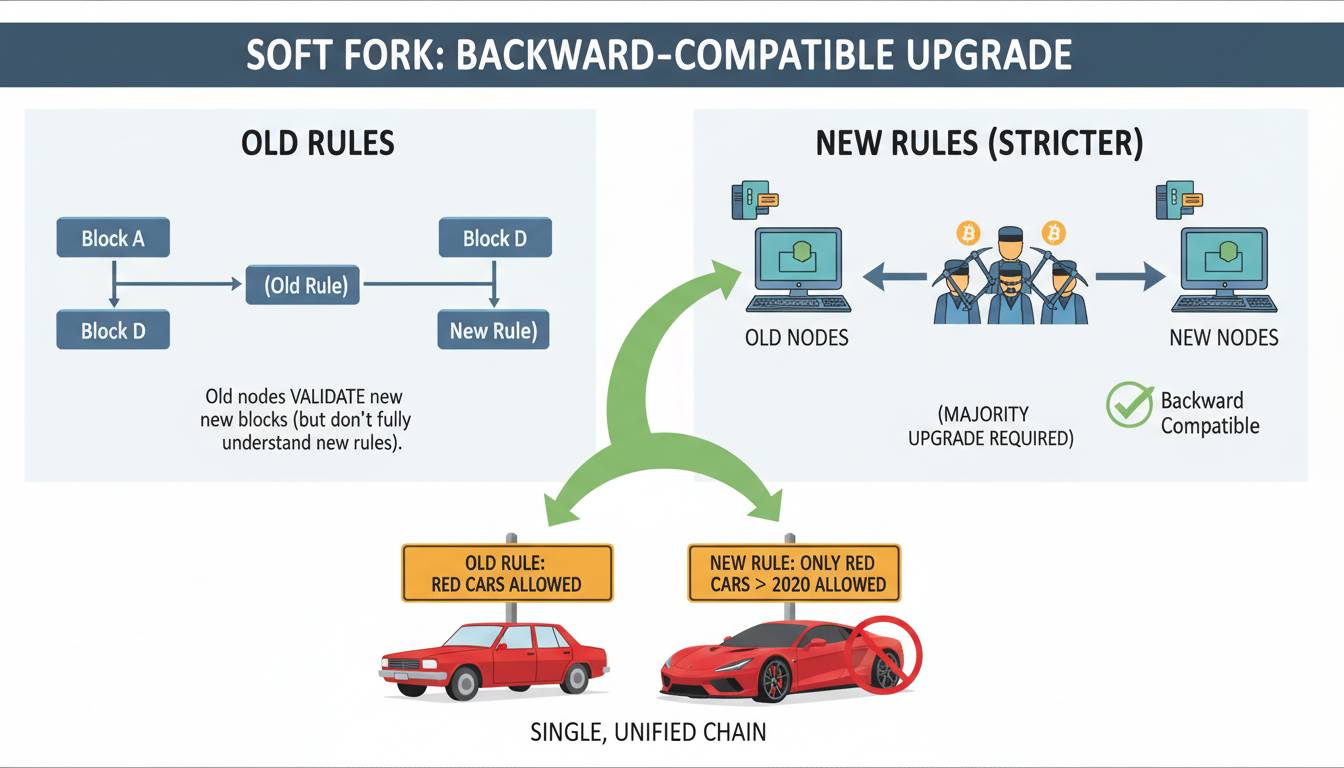
A soft fork is a change to the blockchain’s protocol rules that remains compatible with older versions of the software. Think of it as adding a new lane to a highway: existing lanes still work, but cars can now use the new lane too. Nodes running older software can still validate new blocks as long as they follow the stricter rules, even if they don’t fully understand them.
Here’s how it works in practice. In a soft fork, the new rules are more restrictive than the old ones. Old nodes accept blocks that follow the new rules because those blocks also satisfy the old rules—just more strictly. It’s like a law becoming more specific: the old law still applies, but the new version narrows what’s permitted. Full nodes running the updated software enforce the new rules, while older nodes remain on the network, eventually upgrading when they’re ready.
The Segregated Witness (SegWit) upgrade to Bitcoin, activated in August 2017, is the most famous soft fork example. SegWit changed how transaction data is stored, increasing the blockchain’s transaction capacity without changing the block size limit. Nodes that hadn’t upgraded could still participate in the network because the new blocks were technically valid under the old rules—they simply couldn’t take full advantage of the efficiency improvements.
Soft forks have significant advantages. They’re less disruptive because users aren’t forced to upgrade—older nodes remain functional. They maintain network continuity, avoiding the confusion of two separate cryptocurrencies. And they’re safer from a governance perspective because a single majority of miners can effectively impose the new rules, even if some users disagree.
But soft forks aren’t magic. They require a supermajority of miners to enforce the new rules; otherwise, the network can stall. And they can’t introduce fundamental changes to the protocol’s structure—they can only restrict what’s already allowed. If you want to expand the rules rather than tighten them, or if you want to make a dramatic structural change, you need a hard fork.
What Is a Hard Fork?
A hard fork is a protocol change that breaks backward compatibility. Old versions of the software can no longer validate blocks on the new chain. It’s not adding a new lane to the highway—it’s building an entirely different road with different rules. Anyone staying on the old software is now on a separate network.
When a hard fork occurs, anyone holding cryptocurrency on the original chain automatically receives an equivalent balance on the new chain. This is why forks like Bitcoin Cash and Ethereum Classic created “free money” for holders of the original coins. The two chains share a history up until the fork point, but after that, they diverge completely.
Hard forks can be planned upgrades—Ethereum’s transition from proof-of-work to proof-of-stake in September 2022 was a hard fork, though it didn’t create a competing chain because nearly everyone migrated to the new version. But hard forks also happen when communities split irreconcilably. Bitcoin Cash proponents believed Bitcoin needed larger blocks to handle more transactions; the original Bitcoin developers disagreed. Rather than compromise, the fork happened, and both chains existed independently.
The critical question with hard forks is whether the original chain survives. Sometimes the minority chain withers and dies—the original Ethereum chain essentially ceased to exist after the 2022 merge. Other times, both chains persist. Bitcoin Cash and Ethereum Classic have maintained active communities and trading markets for years, even as they remain smaller than their parent chains.
Hard forks offer unlimited flexibility—you can change anything about the protocol when you’re not constrained by backward compatibility. But that flexibility comes at a cost. They fragment the community, dilute network effects, and can confuse users who suddenly have two versions of their favorite coin. They’re the nuclear option in blockchain governance: powerful, but not without consequences.
Soft Fork vs Hard Fork: Key Differences
The distinction between soft forks and hard forks comes down to one question: can older software continue participating in the network?
In a soft fork, the answer is yes. The new rules are a subset of the old rules, so older nodes can still validate blocks—they simply might not recognize all the features of the new blocks. The network remains unified, and users aren’t forced to upgrade.
In a hard fork, the answer is no. The new rules are incompatible with old ones. Anyone staying on the old software is now on a separate blockchain. Users must upgrade to participate in the new chain.
This fundamental difference cascades into every other aspect:
| Aspect | Soft Fork | Hard Fork |
|---|---|---|
| Backward Compatibility | Yes | No |
| Old nodes can participate | Yes (with limitations) | No |
| Creates new cryptocurrency | No | Often yes |
| Requires supermajority | Yes (miner adoption) | Community consensus |
| Network continuity | Maintained | Broken |
| Example | SegWit (Bitcoin) | Bitcoin Cash, Ethereum Classic |
Neither is inherently better. Soft forks are more conservative—they preserve unity but limit what changes you can make. Hard forks are more radical—they enable dramatic change but risk splitting the community. The choice depends on what the network is trying to achieve.
Here’s what many articles get wrong: they present hard forks as “bad” and soft forks as “good.” That’s oversimplified. The 2016 Ethereum hard fork that created Ethereum Classic was controversial precisely because some members of the community believed the original chain should die—they thought the fork was morally wrong, that it violated the immutability principle that makes blockchain valuable. Others argued it was the only way to recover stolen funds. Neither side was wrong. Hard forks force philosophical decisions that soft forks can avoid.
Famous Blockchain Forks in History
Understanding forks requires seeing them in action. These are the most significant forks in crypto history:
**Bitcoin Cash ** — The most prominent Bitcoin fork. Developers and miners who wanted larger block sizes (8MB versus Bitcoin’s 1MB) forked to create Bitcoin Cash, arguing that Bitcoin had become unusable for everyday transactions. Bitcoin Cash initially had substantial support, but over the years, its market share has declined significantly compared to Bitcoin.
**Ethereum Classic ** — When hackers exploited The DAO, a smart contract that had raised $150 million in ETH, the Ethereum community voted to hard fork and return the stolen funds. A minority refused, arguing that code is law and the blockchain should never be reversed. They continued on the original chain, which became Ethereum Classic. ETC still trades today, though it’s worth roughly 1/20th of Ethereum at writing.
**Bitcoin SV ** — Another Bitcoin Cash fork, this time from developers who believed in even larger block sizes and a more literal interpretation of Satoshi Nakamoto’s original vision. The fork was contentious and led to significant legal disputes.
**SegWit ** — Not a fork in the sense of creating a new coin, but a soft fork that activated on Bitcoin. It remains the most significant recent Bitcoin upgrade, demonstrating that the network can evolve without splitting.
Each of these forks tells a story about community values, technical disagreements, and the challenges of governing decentralized networks. They weren’t just technical events—they were social and political ones.
What Happens to Your Crypto During a Fork?
If you hold cryptocurrency when a fork occurs, you now hold that currency on both chains. This is automatic and happens at the protocol level—there’s no special action you need to take to receive the forked coins.
In practice, this means if you held Bitcoin on August 1, 2017, you suddenly also held Bitcoin Cash. If you held Ethereum on July 20, 2016, you suddenly also held Ethereum Classic. The private keys that controlled your original coins control the forked coins too, because both chains use the same cryptographic keys.
Exchanges complicate this. When a fork is announced, exchanges typically pause trading and deposits until they assess the situation. They’ll often credit users with forked coins once the new chain is stable—but they don’t always do this, and their policies vary. If you’re holding significant crypto, it’s worth understanding your exchange’s fork policy before a fork occurs.
One important caveat: not all forked coins have value. Many chains that fork quickly become abandoned, their tokens worthless. The “free money” from forks only matters if the new chain survives and trades on exchanges. Bitcoin Cash and Ethereum Classic are the exceptions, not the rule. Most forks die within months.
Conclusion
Blockchain forks aren’t failures—they’re features. They represent the decentralized nature of blockchain governance, where no central authority can force everyone to agree. Sometimes forks fix bugs or add features everyone wants. Sometimes they resolve irreconcilable philosophical differences. And sometimes they create entirely new cryptocurrencies that outlive their parents.
Understanding the difference between soft forks and hard forks isn’t just technical trivia. It’s understanding how blockchain communities make decisions. It’s knowing what happens to your coins when the network changes. And it’s recognizing that behind every fork, there’s a human disagreement about what the system should become.
The next time a fork happens—and it will—you’ll know exactly what’s at stake.
Frequently Asked Questions
What is the difference between a soft fork and a hard fork?
A soft fork is backward-compatible, meaning old nodes can still participate in the network after the upgrade. A hard fork is not backward-compatible, requiring everyone to upgrade or risk being left on a separate chain.
Is Bitcoin a hard fork?
No. Bitcoin itself has never hard forked into a competing chain that survived. Bitcoin Cash and Bitcoin SV are forks from Bitcoin, but Bitcoin has never forked. The closest it came was the SegWit2x proposal in 2017, which was cancelled before activation.
Can a hard fork reverse transactions?
Yes. A hard fork can include any changes, including reversing transactions. The Ethereum hard fork after The DAO hack explicitly reversed a major theft by rolling back the blockchain. That’s precisely why Ethereum Classic exists—some community members refused to accept the reversal.
Which is better: a soft fork or a hard fork?
It depends on what you’re trying to achieve. Soft forks are safer and preserve unity but limit the scope of possible changes. Hard forks enable dramatic restructuring but fragment the community. Neither is universally better.