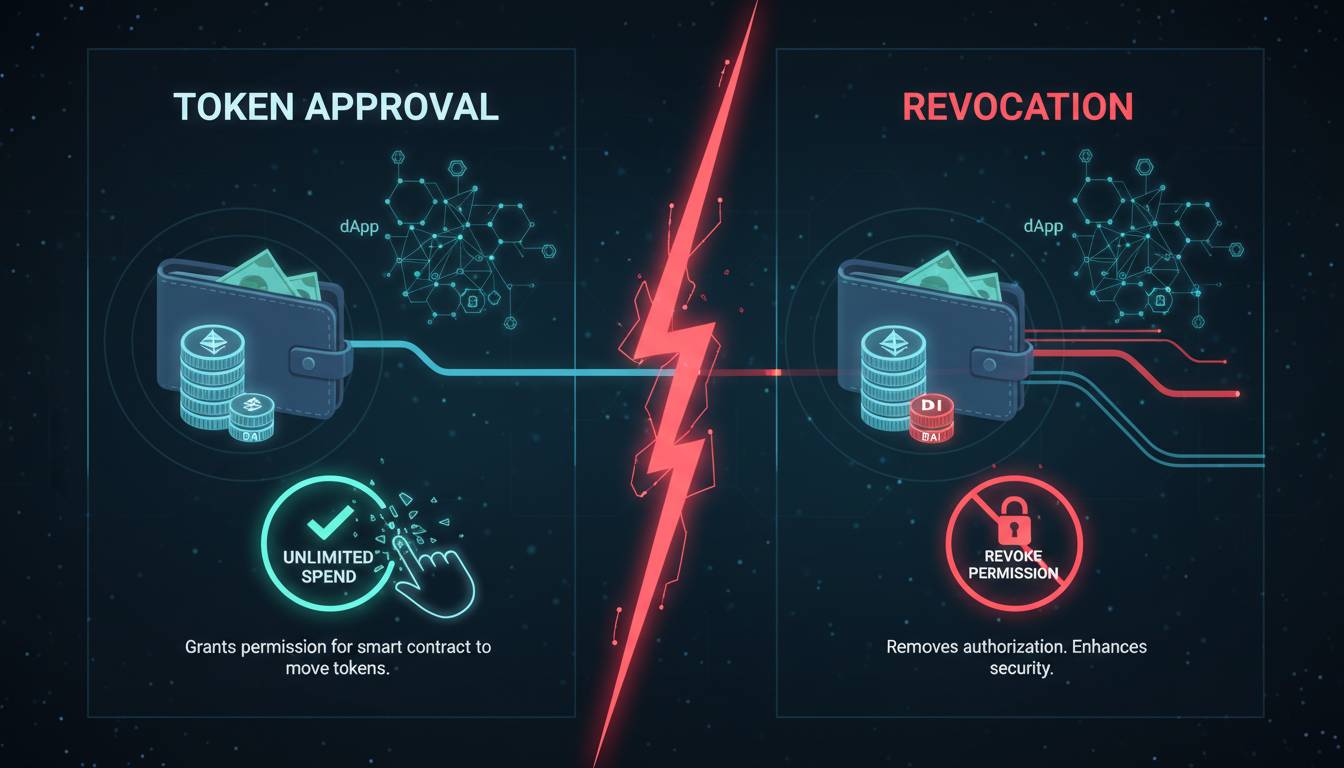
If you’ve ever connected your wallet to a decentralized exchange, staked tokens in a yield farm, or signed a transaction on a DeFi protocol, you’ve almost certainly granted what the industry calls “token approvals” — and chances are you’ve forgotten about them entirely. That’s a problem. These permissions sit quietly in your wallet, giving smart contracts ongoing access to move specific tokens on your behalf, and they’re one of the most common attack vectors for crypto theft. The good news: revoking them takes minutes and could save you everything.
What Token Approvals Actually Are
When you interact with a decentralized application, you’re not just making a one-time transaction. You’re giving that application’s smart contract permission to access your tokens — specifically, to transfer them from your wallet without requiring your signature on every single trade. This is the token approval mechanism, and it’s fundamental to how DeFi works.
Here’s the typical flow. You visit a DEX like Uniswap to swap USDC for ETH. The interface asks you to “approve” USDC spending. You sign the transaction, and now Uniswap’s router contract can pull USDC from your wallet whenever you initiate a swap. The approval specifies which token can be spent and how much of it. The detail most people miss is that many apps request an unlimited allowance by default — meaning they can eventually access your entire balance, not just the amount needed for the immediate transaction.
MetaMask, Rabby, and other wallet interfaces usually present this as a slider or input field. You can set a specific amount, but most users click “Approve” without thinking twice. I made this mistake myself in early 2022 when I first started using DeFi protocols, and I know dozens of others who’ve done the same. The convenience of unlimited approvals saves users from signing new approval transactions every time they want to trade, but it creates a permanent security liability.
Why These Approvals Represent Real Danger
The risk isn’t theoretical. In 2022 alone, attackers drained hundreds of millions of dollars from DeFi users by exploiting vulnerabilities in approved token contracts or simply compromising the dApps users had authorized. When you grant unlimited approval to a protocol that later gets hacked, your tokens become accessible to whoever controls the exploited contract. You didn’t lose your private keys, you didn’t fall for a phishing link — you just used a legitimate application and forgot to clean up afterward.
Uniswap’s router contract has been exploited multiple times. Several lending protocols have suffered attacks that drained user funds through approved tokens. In the worst cases, users lost everything not because their own security was weak, but because a trusted protocol became a liability. This is the problem with token approvals: you’re extending trust not just to the protocol you used today, but to every future version of that contract and anyone who gains control of it.
There’s also the matter of abandoned projects. Thousands of DeFi protocols launched in 2020 and 2021 are now inactive — their teams dissolved, their social media gone, their smart contracts untouched for years. If you approved spending on any of these, those permissions remain active in your wallet indefinitely. The contracts might still function, and if anyone discovers a vulnerability in them later, your funds are exposed. The project being “dead” doesn’t make your approval any less risky.
How to Find Out What You’ve Approved
Before you can revoke anything, you need to see what approvals are currently active in your wallet. Several free tools aggregate this data directly from the blockchain, making the process straightforward even for non-technical users.
Revoke.cash is the most widely used option. You connect your wallet — MetaMask, WalletConnect, Coinbase Wallet, or hardware wallets via their browser extension — and the site displays every active approval tied to your address. Each entry shows the token, the spender contract, the amount approved, and when you last interacted with that protocol. The interface is clean and color-codes approvals by risk level, flagging unlimited allowances in red.
Unrekt offers similar functionality with a slightly different interface and supports more chains. Debank provides a more comprehensive DeFi portfolio view that includes approval tracking alongside your full asset positions across multiple chains. For users with positions across Ethereum, Arbitrum, Optimism, Polygon, and other networks, these multi-chain tools are essential since approvals are chain-specific — approving a token on Ethereum doesn’t affect your assets on Polygon.
I checked my own wallet on Revoke.cash last month and found 14 active approvals, many from protocols I hadn’t used in over a year. Three of them had unlimited allowances. Removing those took about ten minutes total.
The Revocation Process: Step by Step
Once you’ve identified an approval you want to remove, the actual revocation is straightforward. On Revoke.cash, you simply locate the approval in your list and click the “Revoke” button next to it. Your wallet will prompt you to sign a transaction that sets the approved allowance to zero. This transaction costs a small gas fee, typically just a few dollars on networks like Ethereum, though it varies with network congestion.
The same applies across other tools. Unrekt and Debank follow identical patterns — find the approval, click revoke, confirm the transaction. If you’re using a hardware wallet like Ledger, you’ll need to confirm the revocation on the device itself, which adds an extra layer of security.
One thing worth noting: revoking an approval doesn’t affect any tokens currently staked or deposited in a protocol. If you’ve supplied assets to a lending market or liquidity pool, those positions remain intact. The revocation only affects the contract’s ability to pull new tokens from your wallet. However, if you plan to stop using a protocol entirely, you’ll want to withdraw your deposited funds first, then revoke the approval.
Some users worry that revoking approvals might break something they’re still using. The honest answer is that it depends on your intent. If you intend to continue using a DEX or lending protocol, don’t revoke that specific approval — you’ll just need to re-approve when you want to trade, and that costs extra gas. But for any protocol you’ve moved away from, there’s no downside to cleaning up.
How Often Should You Do This
There’s no official standard, but I’d recommend checking your approvals at minimum once every three months, and ideally monthly if you’re actively using DeFi. Beyond a regular schedule, you should also review and revoke approvals immediately after finishing any interaction with a new protocol. Connect, trade, then revoke. Make it a habit.
This is especially important after using any application for the first time. The initial interaction is when you’re most likely to have granted an unlimited allowance, and it’s also when the approval is freshest in your mind. A few weeks later, you won’t remember which obscure token swap platform you used once, but the approval will still be there.
Some security-conscious users take an even more aggressive approach: they use a dedicated “DeFi wallet” for all protocol interactions, keeping their long-term holdings in a separate cold or hardware wallet. Even if the DeFi wallet gets drained through a compromised approval, the majority of their assets remain untouched. This separation strategy isn’t practical for everyone, but it’s worth considering if you’re managing significant value.
Tools Worth Using
Beyond Revoke.cash and Unrekt, a few other options deserve mention. CoinTool offers approval management across an impressive range of chains. Approved.zone provides a simpler interface focused on the most common networks. If you use Rabby wallet, it has built-in approval tracking and revocation functionality that integrates directly into the wallet interface, eliminating the need to visit a separate website.
For teams or heavy DeFi users managing multiple wallets, some services offer API access for bulk revocation, though these are typically paid tools aimed at professional traders or fund managers.
What Nobody Talks About
Here’s the uncomfortable truth: even the act of revoking approvals isn’t perfectly safe. Every transaction you broadcast to the blockchain is public, and sophisticated attackers could theoretically monitor mempool activity, identify wallet addresses with high-value token approvals, and attempt to exploit them before the revocation confirms. This is rare in practice, but it’s not impossible. Using privacy-focused RPCs, conducting revocations during low-traffic periods, or batching revocations into a single transaction through a smart contract can reduce exposure.
Most users don’t need to worry about this level of threat. But if you’re managing eight or nine figures in crypto, the additional precautions are worth considering.
The other honest admission: no tool can guarantee it has found every single approval. Blockchain data is public but not always perfectly indexed, and some obscure protocols use non-standard approval patterns that may not appear in standard dashboards. If your threat model is extremely high, manual verification through block explorers is the only completely reliable method.
Moving Forward
Token approvals are a necessary part of using DeFi, but they create persistent exposure that most users never think about again after their first transaction. The solution isn’t to stop using these applications — it’s to manage your permissions actively. A thirty-second check today could prevent a catastrophic loss tomorrow.
Set a calendar reminder. Make revocation part of your post-trade routine. Your future self will thank you.